
Who Teaches the Librarian to Teach AI
Everyone suddenly expects the librarian to explain AI. But who taught them, and who gets to decide what library AI becomes.
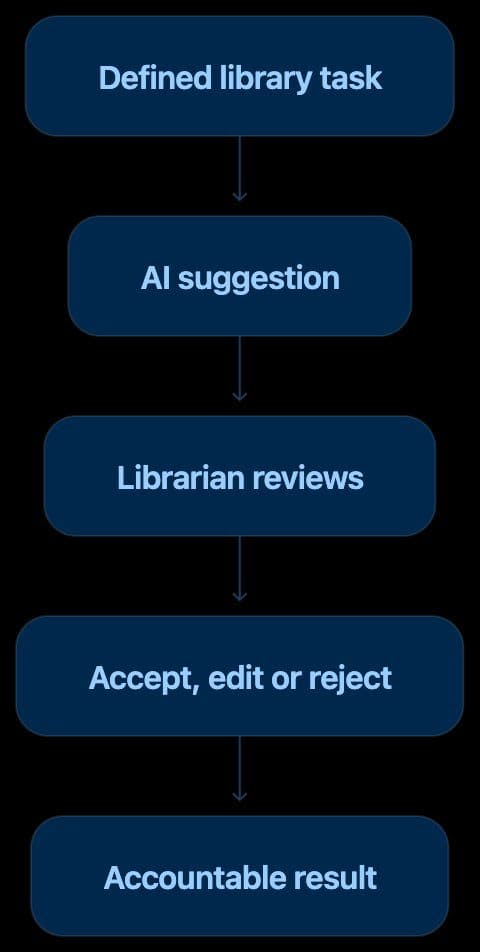
Libraries are being asked to help people understand AI. But who is teaching the librarians, and who gets to decide what library AI becomes?
Suddenly, everyone expects the librarian to be an AI teacher. Can I trust this answer? Is using it cheating? Does it remember what I type? How do I cite it? Will it take my job? Will it take yours? These questions belong in the library. Librarians already teach people how to find information, question authority, identify bias, protect their privacy and verify what they are told.
The prompt is new but“How do you know?” is one of the oldest questions in the library.
But there is something slightly unreasonable happening here. Librarians are being asked to explain AI to students, teachers and the public while many are still trying to understand it themselves. The responsibility arrived before the training, the policies and, in many cases, the opportunity to explore a suitable application safely.
The Dark Creature in the Room
AI is often discussed as though it were one mysterious creature. It thinks, wants, decides, threatens and occasionally promises to transform the world before lunch.
That language makes a complicated technology easier to talk about. It also makes sensible decisions more difficult. A tool suggesting information for a library record is not the same as an opaque (or OPAC - librarian joke sorrynotsorry) system deciding whether someone receives healthcare, employment or credit. Both may use AI, but their purposes, consequences and risks are entirely different.
The useful questions are more concrete: Which application? Performing what task? Using whose information? Who reviews the result? Who can correct it? Who remains responsible when it is wrong?
The moment we name the application, the task and the accountable human, the creature becomes a tool again.
Fear Is Not the Same as Care
This does not mean the concerns are imaginary. Libraries have particularly good reasons to ask difficult questions about privacy, bias, copyright, intellectual freedom and the increasing power of a small number of technology companies. An AI system can produce incorrect information with great confidence. It can reproduce assumptions hidden in its training data. A badly designed tool can gradually turn professional judgment into little more than approving whatever the machine has already decided.
These are not reasons to panic. They are reasons to look closely.
The opposite of fear is not enthusiasm. It is understanding. AI literacy should not teach people to trust AI. It should teach them what deserves trust, what requires checking and what should be refused.
The Practical Middle
This is where our position at Ossus is a little unusual. We are not discussing a theoretical machine that may one day enter the library. We have built an actual application doing identifiable work in a real library context. That makes the conversation wonderfully practical. We can show what the application receives, what it suggests and where the librarian intervenes. We can show where it is useful, where it is uncertain and where it can be wrong. Most importantly, we can show that the librarian retains the power to accept, change or reject its work.
The application is not evidence that AI is harmless. It is something more useful: an object that can be examined.It is difficult to teach people about a dark creature. It is much easier to teach them about a tool sitting on the desk, doing one visible piece of work. Who Teaches the Librarian? Research suggests that librarians’ confidence in AI is shaped less by age or professional background than by training and organizational conditions. A recent study of 203 library professionals in Turkey found that AI literacy significantly predicted whether librarians considered the technology useful and manageable. The ability to evaluate AI was particularly important.
That makes intuitive sense. Before deciding whether something is useful, you need enough knowledge to assess what it actually does. This does not mean training will make every librarian embrace AI. That's not the purpose - it is making informed professional choices.
Librarians need time to learn, approved tools they can safely explore and clear clear guidelines on how to handle proprietary data. They need permission to challenge vendors, question outputs and say no. They also need practical examples drawn from library work rather than another general presentation about how AI will “change everything. ”AI literacy cannot become one more responsibility quietly placed on an already crowded library desk.
Teaching the Teachers
There is evidence that the public already sees libraries as part of the answer. A recent survey of 250 undergraduates found considerable uncertainty about the reliability, origins and originality of AI-generated information. Students identified library instruction and workshops as important places to learn about it. Again, this makes sense. A librarian does not need to explain every layer of a neural network. They need enough understanding to help someone ask:
- Where might this answer have come from?
- Can it be verified?
- What personal information should never be entered?
- Is this the right tool for this task?
- What part of my own thinking am I handing over?
Those are information-literacy questions.
Librarians Should Teach AI Too
Librarians should not only receive training after an AI application has been built. They should have a voice in its development. A peer-reviewed co-design study found that accessible explanations helped people without technical backgrounds ask broader and more critical questions about proposed AI systems. It also helped technical and nontechnical participants find common ground while designing them.
Librarians bring knowledge that developers may lack. They understand how classification affects discovery, how innocent-looking language can hide assumptions, where privacy can be lost and which errors are merely inconvenient rather than genuinely harmful. Developers can teach an application how to perform a task. Librarians have to teach us whether it is the right task, what good performance looks like and where the machine should stop. That is the second meaning of teaching AI.
Off to Gothenburg
Libraries should not become AI showrooms where every new feature is treated as progress. Nor should they become museums where AI is discussed only as a threat outside the walls. They can become places where AI is made understandable. That requires tangible applications, visible human oversight and professionals who have been given the confidence to ask difficult questions. It also requires developers willing to listen when the answer is uncomfortable.
This week we are heading to the Gothenburg Book Fair, taking place from 24 to 27 September, and we could not be more excited. We will be there with an actual application, doing actual library work, ready to be examined, questioned and probably challenged. Exactly as it should be.
Come find us.
We will be strutting our stuff, talking about books, libraries and AI, and showing precisely where the human judgment still lives.
Notes
- Footnote 1.Kavak, A., Gültekin, V. and Özel, N. “How Does AI Literacy Shape Technology Acceptance? A Cross-sectional Study Among Library Professionals.” The Electronic Library, 2026. ↩
- Footnote 2.Marchese, M. M. and Marchese, A. “Survey on Undergraduate Student Use of Generative AI: Implications for Information Literacy in Academic Libraries.” College & Research Libraries, 2026. ↩
- Footnote 3.Smith, F. et al. “Codesigning AI with End-Users: An AI Literacy Toolkit for Nontechnical Audiences.” Interacting with Computers, 2025. ↩
Filed under
- Field Notes
- libraries
- artificial intelligence
- ai literacy
- librarianship
- information literacy
- gothenburg book fair

Librarian
A librarian who wrote her dissertation on integrated library systems, and now helps build one. She is making sure the shift to AI is threaded with care, so it works for librarians and the communities they serve, not in place of them.