
Stories from the Inside
How a handful of activists trying to get books to one jailed friend became thirty thousand books a year, and why that floor is now cracking.
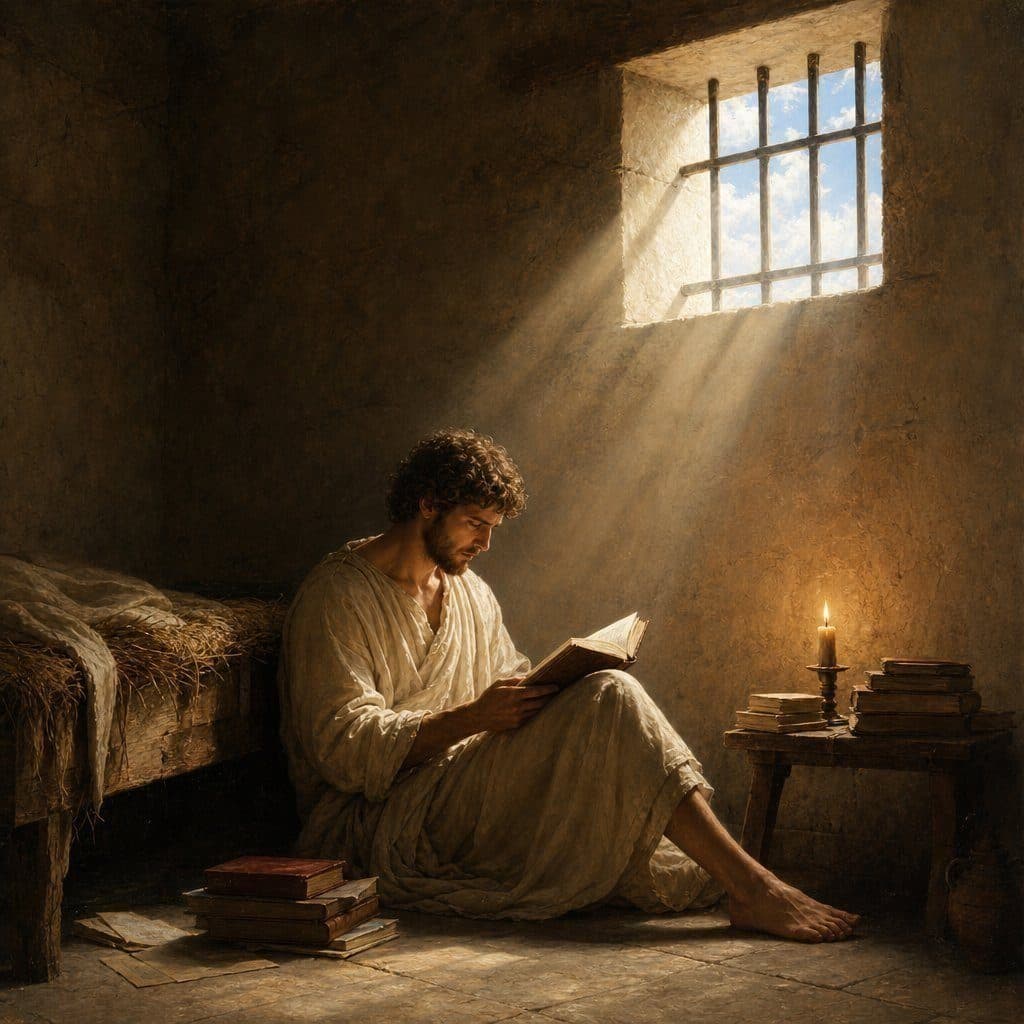
I have this working thesis that many librarians harbor a deep desire to write the books they are shepherding themselves: they nourish secret dreams of seeing their own title there on the shelf with the other New Arrivals! For one reason or another they just haven't gotten around to it yet. …and here I am. Maybe I'll come back to that at some stage.
To that point, I have quite the letter production in my drawers and due to happy circumstances I have become a part of a wonderful writers community called The Back Story Above, located on top of the legendary Green Apple on the Park Books shop here in San Francisco. Before we move on, can we talk about the smell? The fresh, crisp aroma of stationery. The musty scent of the antiquarian book shop. Both bring me to this happy, calm place — right alongside mom's newly baked cinnamon rolls, wet grass, kitten bellies, and the Baltic sea. All on my top ten. The Green Apple smells just right, so before heading home, I lingered — walked the shelves a while longer than I meant to — and my eye fell on something I'd never seen before.
A tall bookshelf with random books on display, with a sign reading "Donate a book to the incarcerated, either by their wishlist or any new book of your choice." My interest was piqued, and I asked how I would go about doing this, and I ended up buying three books straight off the wishlist bat. If you're anything like me you're clearly wondering "which ones, spill it!" so: The Hitchhiker's Guide to the Galaxy (I mean, 42!), Six of Crows (because Leigh Bardugo's characters are as strong as they come) and finally a really pretty book on woodworking, a subject I managed quite well in school (unlike my sewing, which was a true disaster).
Then I have added a book each time I'm there. Next time I plan on choosing something myself to add, but actually fulfilling someone's book wish is pretty powerful, even though we'll never meet. I was always given all the books I wanted, one way or another, borrowed, second hand (loppis, in Swedish), as gifts, or saved up for myself, so the idea of being without is somehow not acceptable to me. I don't need someone to thank me. I need someone to get a couple of hours of escapism, or the opportunity to learn something new, about themselves, or about woodwork.
The idea of pulling yourself out of your own situation by reading is very compelling to me. If their outside world has shrunk to nothing, their inside world can keep expanding.
There are no limits to the life you can lead in your head.
What I didn't know, standing at that shelf with three books in my arms, was that I'd stumbled into something with a much longer history than a single afternoon at Green Apple.
The program the shop partners with, the Prisoners Literature Project, didn't start as an institution at all. It started in 1980 or '81, in the back room of Bound Together Books, a volunteer-run anarchist bookstore a few blocks away on Haight Street that's still standing today. A handful of activists set it up for one reason: to get books to a friend of theirs who was in jail. That's it. Just some people who wanted their friend to have something to read.
"It was designed initially just to get books to a friend of the people who set it up," is how longtime volunteer Karen Franklin puts it. Word got out, not through a marketing campaign, but the way things spread inside: person to person, letter to letter. What started as five or ten requests a month grew into something the founders surely never planned for. The project moved across the bay to Berkeley in the 1990s, and today it runs on roughly 300 volunteers rotating through three-hour shifts, about 20 evenings a month, sending out some 30,000 books a year to people in over 1,000 prisons, jails, and juvenile facilities across the country. All of it on an annual budget of about $250,000, a third of which goes straight to postage, and not a single paid staff member in the building.[2]
One friend. One back room. Forty-five years later, thirty thousand books a year
This story got me wanting to know more, and I found a man named Martin Sostre, and what a man! He fought for the right to read secular literature in prisons, and by the time he was done, he'd rewritten the rules for what any incarcerated person in America was allowed to read at all.
He was a self-taught jailhouse lawyer, and from inside prison, he kept filing, and kept winning: first securing incarcerated Muslims' right to their own religious texts, then ending the practice of throwing prisoners into solitary confinement simply for possessing literature the authorities didn't like, and eventually forcing prisons to actually justify, in writing and within a set time limit, any book they refused to let in.[3]
He died in 2015.[3] Every book that's ever reached someone through PLP, or Green Apple's shelf, or any of the programs I've come across this week, is downstream of a man who spent years in solitary confinement to win the right to read something other than what he was handed.
I'd love to be able to say that there are recent statistics clearly stating that reading itself, all on its own, keeps people from going back to prison. The truth is a little more modest than that, though not by much.
RAND ran the largest meta-analysis of correctional education ever done, and the numbers are striking: people who take part have 43% lower odds of returning to prison, a real 13-percentage-point drop, are 13% more likely to find work after release, and every dollar spent saves four to five in reincarceration costs within three years. Strong enough that the US Attorney General and Secretary of Education pointed to it as reason to expand these programs nationwide.[1]
Here's the catch: that's correctional education broadly, not reading alone. RAND couldn't isolate reading's own effect with the same certainty it found for math. But reading sits underneath nearly all of it. You can't get through a college course without reading your way through it first.
It's not the headline number. It's the floor everything else stands on.
One detail stopped me longer than the rest: children's books are one of the things prisoners ask for most often. Not law books. Not even dictionaries, though those come close. Children's books. My first thought was that it must be for when the kids visit, something to read together in a visiting room, which felt moving enough on its own. It wasn't that. Or not only that.
Programs like Reading Legacies, and the Children's Literacy Foundationbefore it, have built something quieter: a parent, recorded on video or audio, reading a children's book aloud, sent home to a kid alongside the physical book itself, not just a copy of the story, but the actual sound of their parent's voice, something to return to whenever they want.[5]
Bobby used it during four months inside. He recorded himself reading a Frozen book to his four-year-old daughter, Jazzy. In his own words: "If you're missing or lacking connection with your kids, reading books to them is a passageway into rebuilding that connection."[4]
None of this is guaranteed to last, and that's the part I need to say plainly before I let you get on with your day.
In March 2025, an executive order aimed at shrinking federal agencies reached the Institute of Museum and Library Services, the main source of federal library funding in the US. Within weeks, IMLS began cancelling its Grants to States program, the same funding stream that pays for staffing, materials, technology, and reentry programs in correctional libraries specifically. Not public libraries in general. The ones inside.[6]
In Arkansas, a new policy blocks incarcerated people from receiving physical books directly, citing contraband concerns. The likely result: people fall back on whatever the prison library or a prison-issued tablet already offers, often thin and outdated. The workaround becomes the whole system.[7]
The logic behind cuts like these doesn't hold up.
It's short-sighted math: save money now, pay more later. Every dollar not spent on books and education inside becomes a dollar spent again, later, on the 13 percentage points of people who didn't have to come back.
How do we safeguard that the Jazzys of the future will have something to talk about when daddy calls, and that the Sostres of the world can still educate themselves on the inside?
----------------------------------------------------------------------------------------
- RAND Corporation, "Evaluating the Effectiveness of Correctional Education: A Meta-Analysis of Programs That Provide Education to Incarcerated Adults," rand.org
- Berkeleyside, "Berkeley's Prisoners Literature Project has been mailing books to inmates for 4 decades," July 2, 2026
- PEN America, "The Legacy of Martin Sostre (1923–2015)," pen.org
- News San Diego (KGTV), "Building bridges through books: Local program connects incarcerated parents with children through reading," Oct. 11, 2025
- Federal Reserve Bank of Boston, "Books Behind Bars: Connecting Inmates to Their Children Through Reading," bostonfed.org
- gov1.com, "Prison libraries brace for staffing and program cuts after IMLS funding loss," Jan. 14, 2026
- Arkansas Advocate, "Arkansas inmates restricted from receiving physical books, other media directly under new policy," Dec. 19, 2025
Notes
- Footnote 1.✦ The Children's Literacy Foundation (CLiF) — runs parent-and-child literacy programs across 17 correctional facilities in New Hampshire and Vermont. Their model has spread far enough that prisons in New York, Colorado, Wisconsin, and Florida have since asked how to set one up themselves. ↩
Filed under
- Field Notes
- prison literacy
- incarceration
- books
- reading programs
- martin sostre
- prisoners literature pro
- RAND
Librarian
A librarian who wrote her dissertation on integrated library systems, and now helps build one. She is making sure the shift to AI is threaded with care, so it works for librarians and the communities they serve, not in place of them.